












Satellite Internet

61
A portable flat BGAN terminal open on the tailgate of a pickup at a remote site, laptop beside it, dusk light, no people looking at camera

Satellite Internet

Satellite Internet Terminals for Land, Sea and Remote Assets

Portable BGAN and Certus terminals, in-motion vehicle systems, maritime VSAT and GMDSS, and the Iridium modules that connect unmanned equipment.

What satellite internet is, and what it is not

The call comes in at 2 a.m.: a pipeline compressor station 90 miles from the nearest cell tower has gone dark, and the crew heading out needs to send photos, pull drawings and get on a video call with the engineer once they arrive. That is the job satellite internet does. It puts an IP connection where no fibre, cable or cellular signal exists, using a terminal that talks directly to a satellite.

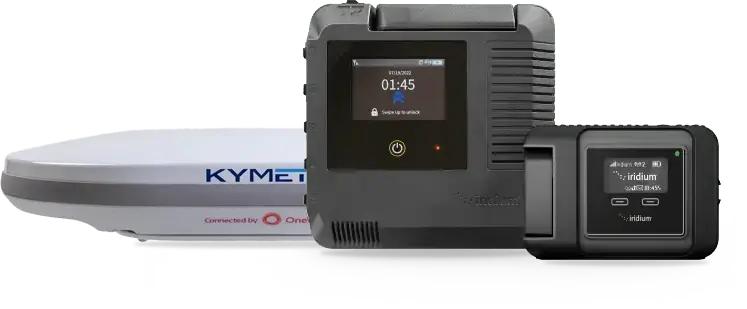
Satellite internet is a different class of equipment from a satellite phone or a hotspot such as the Iridium GO. A GO carries voice, texts and a handful of purpose-built apps for weather and compressed email. It will not load a normal web page. The terminals on this page open a true data connection: browsers, VPNs, cloud apps, video calls and file transfer, at speeds that depend on which network the terminal uses.

That last point is the whole buying decision. Speed, coverage, weather resilience, whether the unit works while moving, and how much power it draws are all set by the network and the antenna, not by the brand on the box. The sections below walk through the classes so you can pick the right one, then hand you to the subcategory where the matching hardware lives.

The three classes of satellite internet, by network

Every terminal we sell belongs to one of three technology families. Pick the family first; the model choice inside it is much easier.

Close-up of a BGAN portable terminal being pointed at the sky by a field technician in a hi-vis vest

L-band: BGAN, Iridium Certus and Thuraya IP

Small antennas, usually no moving parts, and a signal that shrugs off rain. Inmarsat BGAN runs standard IP up to 492 kbps and streaming in excess of 384 kbps. Iridium Certus tops out at 704 kbps down and 352 kbps up on the Certus 700 tier, with 88 kbps and 176 kbps tiers below it. Thuraya IP delivers up to 444 kbps standard IP. This is the class for portable kits, first responders, media crews and anything that must work in bad weather.

Explore →
A stabilised VSAT dome mounted on the mast of a commercial vessel, open water behind it

Ku and Ka-band VSAT: Global Xpress, Fleet Xpress and Ku networks

Parabolic or flat-panel antennas from 65 cm to 1 m that track a geostationary satellite. This is where speeds move from kilobits to megabits: the Intellian GX60 is rated up to 50 Mbps on Global Xpress, and Fleet Xpress plans on a SAILOR 800 run from 1024 kbps down and 512 up to 8192 down and 4096 up. Heavier, more power-hungry and more affected by heavy rain than L-band, but the right answer for a crewed vessel, a drive-away command post or a remote camp with many users.

Explore →
A flat Starlink-class panel mounted on the roof rack of a work truck at a remote construction site

LEO broadband: Starlink

Low Earth orbit constellations use a flat electronically steered antenna and deliver hundreds of megabits; the Starlink Performance terminal is listed at up to 400+ Mbps download. Satmodo supplies Starlink for business and enterprise use only, and it has its own section of the site with hardware, mobility and maritime plans. If your job is a fixed site, a fleet or a vessel with a clear sky view and a power budget to match, start there.

Explore →

How fast is satellite internet? Honest numbers by network

Rated speeds from the network operators and the product pages. Real throughput is lower under load, at low elevation angles and in heavy weather. Treat these as ceilings, not promises.

Inmarsat BGAN (L-band)Iridium Certus (L-band)Thuraya IP (L-band)Ku / Ka VSATStarlink (LEO)
Typical terminalEXPLORER 510, EXPLORER 710, Hughes 9211-HDRThales MissionLINK, VesseLINK, SAILOR 4300Thuraya IP Plus, IP VoyagerSAILOR 800, Intellian GX60, EXPLORER 8100GXStarlink Performance, Enterprise
Rated downloadUp to 492 kbps standard IP; HDR streaming up to 650 kbps per channelCertus 700: up to 704 kbps; Certus 200: 176 kbps; Certus 100: up to 88 kbpsUp to 444 kbps standard IPMegabits: GX60 rated up to 50 Mbps; Fleet Xpress plans up to 8192 kbpsUp to 400+ Mbps (Performance terminal)
Rated uploadSymmetric standard IP; streaming rates selectableCertus 700: 352 kbps; Certus 200: 176 kbpsStreaming up to 384 kbpsFleet Xpress plans up to 4096 kbpsPlan dependent
CoverageGlobal except the poles (geostationary)Pole to pole, 66 satellitesEurope, Africa, Middle East, most of AsiaGlobal Xpress and Ku beams; check the footprint for your routeWhere licensed; check the map
Rain and weatherMinor effectMinor effectMinor effectHeavy rain degrades Ka-band more than KuHeavy rain can reduce throughput
Works in motionClass 11 vehicular units only (EXPLORER 323, 727, Hughes 9450)Yes, omnidirectional antennaVehicular models only (IP Voyager, IP Commander)Only stabilised or flat-panel systemsYes with mobility plans
AntennaFlat panel, hand pointed or auto-trackingOmni, no moving partsFlat panel or auto-tracking dome65 cm to 1 m dish or flat panelFlat electronically steered panel

Sources: viasat.com BGAN service page; iridium.com Certus 700 and Certus 100 pages; satmodo.com product pages for Thuraya IP Plus, Thales VesseLINK 200, Intellian GX60, SAILOR 800 VSAT and Starlink.

How to choose a satellite internet terminal

Five questions, in the order we ask them on the phone.

1

Where will it be used, and does it move?

A terminal that sits still on a tripod can use a hand-pointed flat antenna and will be lighter and use less power. A vehicle that must stay online at highway speed needs a tracking or omnidirectional antenna: the EXPLORER 727 holds 432 kbps while moving over 125 mph, and Certus terminals track with no moving parts. A vessel needs a stabilised dome or an L-band omni, and usually a GMDSS or safety component.

2

What do you actually need to send?

Email, forms, SCADA polls and telemetry fit in tens of kilobits: that is Certus 100, BGAN M2M or even Iridium SBD territory. Browsing, VPN and voice want a few hundred kilobits: BGAN, Certus 700 or Thuraya IP. Live video, cloud backups and a crew of ten sharing the link want megabits: VSAT or Starlink.

3

How bad will the weather be?

L-band signals pass through rain, snow and sandstorms with little loss, which is why emergency managers and broadcasters carry BGAN and Certus. Ka-band VSAT is faster in clear skies and can fade in a downpour. If the link must hold during a hurricane landfall, L-band is the primary and VSAT is the bonus.

4

What power do you have?

A 9603 SBD module transfers a message at 0.8 W or less. A Hughes 9502 idles at 1 W and never exceeds 20 W transmitting, which is why it runs on a small solar panel. An EXPLORER 325 vehicle system can draw 150 W including its PoE ports. A VSAT antenna control unit wants mains or a proper vehicle inverter. Match the terminal to the power you can guarantee.

5

Who is paying for airtime?

Every network bills differently: BGAN and Certus by the megabyte or by streaming minute, Fleet Xpress and Ku by plan tier, Starlink by priority data. The terminal is a one-time cost; the plan is forever. Call (800) 279-2366 and we will size the plan to the traffic before you commit to hardware.

Shop by how you deploy it

Five subcategories. Some terminals appear in more than one because the same hardware can be carried, bolted to a roof or fitted to a mast.

Who buys satellite internet, and what they buy

The same five customers account for most of what leaves our warehouse.

Portable, vehicular, maritime or M2M: how the subcategories differ

Land Mobility covers terminals that a person carries, sets up and takes down, plus drive-away and fly-away dishes that are transported and then parked to work. The antenna is either pointed by hand (EXPLORER 510, Thuraya IP Plus) or auto-acquires once stationary (EXPLORER 8100GX, 5075GX). Fixed remote-site installs also live here, because the hardware is the same.

Vehicular means the link stays up while the wheels turn. That requires a tracking antenna (EXPLORER 323, 325, 727, Hughes 9450-C11, Thuraya IP Voyager) or an omnidirectional one (Thales MissionLINK on Certus). Several models appear in both Land Mobility and Vehicular because a roof-mounted unit also works parked, and a MissionLINK can travel in a case or bolt to a roof. We flag that overlap honestly rather than hide it.

Maritime terminals are built to marine standards for salt, vibration and constant motion, and the category includes safety equipment (Iridium GMDSS) and voice-first systems (Fleet One) alongside pure broadband. Machine-to-Machine covers terminals installed to connect equipment, not people. Short Burst Data is narrower still: the Iridium modules and protocol that M2M and tracking products are built on.

Side-by-side of three antenna types on a white background: a flat BGAN panel, a small omnidirectional Certus antenna, and a stabilised dome

What you need alongside the terminal

The box rarely contains everything the job needs. Budget for these before the first deployment.

An airtime plan on the right network. BGAN, Certus, Thuraya, Fleet Xpress and Ku plans are all sold separately and we activate them for you.
Power. Portable BGAN units run on their own battery for a few hours (the EXPLORER 710 is rated up to 3.5 hours); vehicle systems need 12 or 24 V DC; VSAT wants mains or an inverter. See /off-grid-power for stations and solar.
Mounting hardware. Magnetic roof mounts for BGAN trackers, the Thales mag mount or vessel mount for MissionLINK and VesseLINK, pole mounts for M2M terminals.
A router or network manager if you will combine satellite with cellular or Wi-Fi, or need to stop background updates eating airtime. See /buy/satellite-routers.
For vessels over the tonnage threshold, a GMDSS-approved terminal such as the Lars Thrane LT-3100S, which carries MED and Wheelmark approval.

Popular satellite internet terminals

The models we recommend most often across the five subcategories.

Not sure which class you need?

Tell us where the terminal is going, whether it moves, what it must send and what power is available. A specialist will point you to one or two models, not a catalogue.

Call (800) 279-2366

Keep reading

Frequently asked questions

What is a satellite internet terminal?
A satellite internet terminal is a modem and antenna that opens an IP data connection through a satellite instead of a cell tower or cable. Once connected, laptops and phones use it like any other Wi-Fi or Ethernet link, with speed and latency set by the network it uses. The terminals here run on Inmarsat BGAN, Iridium Certus, Thuraya IP, Ku and Ka-band VSAT networks.
Is an Iridium GO satellite internet?
No. The Iridium GO provides voice, text and data only through specific apps for weather and compressed email, and it will not load a normal web page. The GO exec on Certus 100 is faster but still narrowband and best for email, light apps and voice. For browsing, VPN and video you need a terminal from this section or a Starlink business system.
How fast is BGAN?
Inmarsat BGAN standard IP runs up to 492 kbps, with streaming IP guaranteed in excess of 384 kbps and HDR streaming up to 650 kbps in a single channel. Smaller portable units are rated lower: the EXPLORER 510 is listed at up to 464 kbps. That is enough for email, web, VPN and standard-definition video, not for HD streaming to a crew.
How fast is Iridium Certus?
Iridium Certus comes in three tiers. Certus 700 delivers up to 704 kbps down and 352 kbps up, Certus 200 runs 176 kbps each way, and Certus 100 is rated up to 88 kbps. All three use L-band and an omnidirectional antenna, so they work in motion and in bad weather anywhere on Earth, including the poles.
What is the difference between L-band and Ku or Ka-band?
L-band (BGAN, Certus, Thuraya) uses small antennas and low frequencies that pass through rain with little loss, at speeds in the hundreds of kilobits. Ku and Ka-band VSAT use larger dishes or flat panels at higher frequencies, reaching megabits, but heavy rain degrades the link and the hardware is heavier and hungrier for power. Many vessels run both: VSAT as primary, L-band as the always-on backup.
Which satellite internet works while driving?
Terminals with tracking or omnidirectional antennas. On BGAN, the EXPLORER 323, 325 and 727 and the Hughes 9450-C11 track the satellite from a vehicle roof; the 727 holds 432 kbps above 125 mph. On Certus, the Thales MissionLINK needs no tracking at all. On Thuraya, the IP Voyager and IP Commander are the in-motion models. See the Vehicular subcategory.
Does satellite internet work in rain and storms?
L-band terminals do, with only minor loss, which is why emergency responders standardise on BGAN and Certus. Ka-band VSAT and LEO systems deliver far more speed in clear conditions but can slow or drop in heavy rain. If the link is for disaster response, treat L-band as the one that must work.
What is the difference between Land Mobility and Vehicular?
Land Mobility is equipment that is carried or transported and then set up to work while stationary, including drive-away dishes and fixed remote-site installs. Vehicular is equipment that keeps the connection while the vehicle moves. Some models appear in both because a roof-mounted tracker also works parked.
What is the difference between M2M and Short Burst Data?
Short Burst Data is an Iridium service and the family of transceiver modules (9602, 9603, 9522B, Core 9523) that engineers build into their own products. Machine-to-Machine is the broader category of finished terminals installed to connect equipment, including BGAN M2M units such as the Hughes 9502. If you are designing a product, start at SBD; if you are connecting a site, start at M2M.
How much data does satellite internet use?
The same as any internet connection, which is the problem: a laptop left to update itself can burn a month's BGAN allowance overnight. Plans on BGAN, Certus and Thuraya are sold by the megabyte or by streaming minute, so a satellite router that blocks background traffic pays for itself quickly. Ask us to size the plan against what you will actually send.
Can I use satellite internet on a boat?
Yes, and the Maritime subcategory is built around it. Smaller vessels use Fleet One (up to 100 kbps with voice) or Iridium Certus terminals such as the Thales VesseLINK; larger vessels add Fleet Xpress or Ku-band VSAT domes for megabit speeds. Vessels under GMDSS carriage rules can meet the requirement with the Lars Thrane LT-3100S on Iridium.
Where does Thuraya work?
Thuraya covers Europe, Africa, the Middle East and most of Asia. It does not cover the Americas or anywhere outside that footprint. If your operation is in the Americas or needs true global reach, choose BGAN or Iridium Certus instead.
Do I need a licence to use a satellite terminal?
In the United States the terminals we sell are type-approved and the airtime provider holds the spectrum licence, so a private user does not need one. Some countries restrict import or use of satellite terminals; tell us the destination and we will check before you travel.
What about Starlink?
Satmodo supplies Starlink for business and enterprise customers, with its own hardware, mobility and maritime plans at /buy/starlink. It belongs in the LEO class described above: far faster than L-band, but a different power and sky-view budget. The pages in this section cover the BGAN, Certus, Thuraya and VSAT equipment.
Can I rent a satellite internet terminal instead of buying?
Yes. Portable BGAN and Certus kits are available for short-term rental with airtime included, which suits film shoots, seasonal standby and trials. See /rental/satellite-internet or call (800) 279-2366.
Loading...

Buyer’s Guide: Selecting the Best Satellite Internet Terminal

Satellite internet technology has evolved rapidly, offering solutions that range from ultra-portable units to high-bandwidth enterprise dishes. To find the right system for your specific needs, consider these three primary categories:

Land Mobile and Portable BGAN Terminals

For journalists, aid workers, and solo travelers who need to set up a "mobile office" in minutes, BGAN (Broadband Global Area Network) terminals are the industry standard. These compact devices fit in a laptop bag and connect to the Inmarsat network, providing reliable internet and voice services worldwide. They are ideal for users who prioritize portability and ease of use over massive bandwidth, ensuring you can send emails and file reports from anywhere.

Next-Generation Low Earth Orbit (LEO) Systems

The arrival of LEO constellations, such as Starlink, has revolutionized remote connectivity by offering low-latency, high-speed internet comparable to fiber optics. These flat-panel antennas are perfect for RVs, remote cabins, and businesses that require the ability to stream video, game, or conduct Zoom calls without lag. If your priority is speed and data volume for multiple users, a Starlink Flat High Performance or Standard Kit is likely your best choice.

Maritime and Vehicular Connectivity

Connecting while in motion requires specialized hardware. Our maritime and vehicular internet systems feature stabilized antennas that track satellites automatically as you drive or sail. Whether you need Iridium Certus for 100% global pole-to-pole coverage or a high-speed VSAT system for a yacht, these ruggedized units ensure that your navigation, weather data, and crew communications remain uninterrupted, regardless of speed or sea conditions.

Loading...