
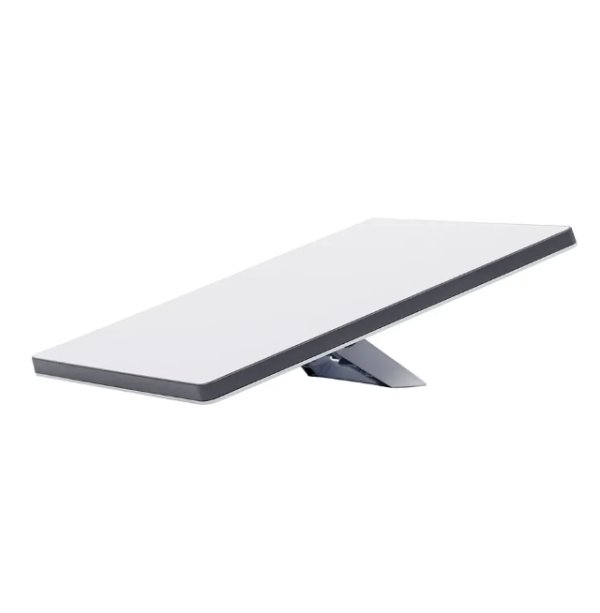
Starlink Mini

2

Starlink Mini: satellite internet you can carry

The Starlink Mini is Starlink's smallest terminal, built to travel in a pack, a vehicle or a site box rather than live permanently on a roof. It runs on DC power, has WiFi built in, and asks for nothing more than a clear view of sky and one cable. It is not the terminal for a crew of thirty or a fixed site with a building on it — see the Standard and Performance pages for that.

Business and enterprise service.
The Starlink Mini terminal

The Starlink Mini is the satellite terminal built to move with one person, not sit permanently on a roof.

It packs the dish, WiFi router and mount into one 1.10 kg unit that runs on 12-48V DC, so it works from a vehicle, a pack or a site box as easily as from a fixed spot. Coverage is roughly a third of the Standard's and the device ceiling about half, which is the trade for the size.

  • Built to travel — one unit, DC powered, no separate router box to mount.
  • Covers a small footprint — up to 112 m² (1,200 ft²) and 128 devices, enough for one vehicle, one tent or a small crew.
  • Rated for the field — IP67 with the DC power cable and Starlink plug installed as shipped, -30°C to 50°C, operational to 96 kph+ wind.
  • Not the terminal for a fixed site with many users — the Standard covers roughly three times the area and nearly twice the devices.
Fit check

Who the Mini is for — and who it isn't

The Mini is the right terminal when the job moves: a vehicle, a portable command post, a solo surveyor, or a kit that has to fit in a case rather than bolt to a structure. At 1.10 kg, it is the only Starlink terminal one person can carry, mount and pack away again in a few minutes.

It is not right for a fixed site with a dozen people on it, or anywhere that wants a permanent mesh network. Coverage tops out at 112 m² (1,200 ft²) and 128 devices — roughly a third of the coverage area, and about half the devices, of the Standard handles from a fixed install. A building, a larger crew, or several structures needing coverage means start on the Standard page instead. A genuinely hostile environment — sustained high wind, submersion, or years outdoors — means the Performance terminal, rated well beyond what the Mini is built for.

Hardware

Starlink Mini specifications

Every figure below is from Starlink's own Mini specification sheet. There is no published download, upload or latency figure for this model — only the Performance terminal has one, so none is invented here.

Starlink Mini
Dimensions298.5 x 259 x 38.5 mm (11.75 x 10.2 x 1.45 in)
Weight (terminal only)1.10 kg (2.43 lb)
Weight with kickstand1.16 kg (2.56 lb)
Weight with kickstand & 15 m cable1.53 kg (3.37 lb)
AntennaElectronic phased array, 110° field of view
OrientationSoftware-assisted manual orienting
Environmental ratingIP67 Type 4 with DC power cable and Starlink plug/cable installed
Operating temperature-30°C to 50°C (-22°F to 122°F)
Wind (operational)96 kph+ (60 mph+)
Snow meltUp to 25 mm/hour (1 in/hour)
Power consumptionAverage 25-40 W; input rating 12-48V 60W
WiFi802.11a/b/g/n/ac, WiFi 5, up to 112 m² (1,200 ft²), 128 devices
RouterIntegrated
Package weight / dimensions2.72 kg (6 lb); 430 x 334 x 79 mm (16.92 x 13.14 x 3.11 in)

Starlink's own sheet states this product is no longer rated IP67 with a standard RJ45 cable — the rating holds only with the DC power cable and Starlink plug installed as shipped.

In the box

What's in the box

The Mini box contains six items: the terminal, with WiFi built in; a kickstand for setting it flat on a roof, deck, bonnet or the ground; a pipe adapter and flat mount for a more permanent fix; a DC power cable; a power supply; and a Starlink plug that connects the cable to the dish. That is everything you get — there is no ethernet cable and no case beyond the flat mount, so budget for those separately if the job needs them.

Setup

Mounting and cabling the Mini

The kickstand suits a flat, temporary sit — a roof, a deck, a bonnet, the ground — and the pipe adapter and flat mount suit something more permanent, such as a roof rail or a fixed pole. Both fittings are Mini-specific: a Standard or Performance mount will not take a Mini, or the other way round.

The cable in the box runs 15 m from dish to plug. A longer DC run and a 3-in-1 cable (USB-C, DC or a vehicle cigarette lighter) exist for vehicle and off-grid setups where the dish sits further from power than the standard cable reaches. See Starlink accessories for the mounts and cables built for this model, not one sized for a different terminal.

Service

Choosing a plan for a Mini

The Mini is hardware only — it needs a service plan, and mobility is included on every plan Satmodo sells, so moving the terminal is never a separate upgrade. What decides the plan is region: a Local plan tied to its issuing territory costs less per gigabyte, while a Global plan follows the terminal across borders and at sea, subject to each territory's regulatory status. Use a regional plan outside its region and the result is not a slower connection — it is no connection.

Several Minis sharing one allowance across a fleet is a pooled plan question, not a per-terminal one. Browse and buy on the plans page, or read how plans work first at Starlink plans explained.

Buy

Starlink Mini terminals and kits

The Mini terminal on its own, in a secure transport case for repeated travel, or built into the Ballistic Max kit for the harshest portable jobs.

Mini Terminal, Mini with Secure Transport Case, and the Mini Ballistic Max Kit — all built on the panel specified above.

Questions

Frequently asked

Up to 112 m² (1,200 ft²) and 128 connected devices, from the WiFi 5 router built into the terminal. That is enough for one vehicle, one tent, one small site office or a handful of people working close together. For a larger footprint or headcount, the Standard covers roughly three times the area and nearly twice the devices from a fixed install.
No. Like every Starlink terminal, it needs a clear, unobstructed view of the open sky — glass, fabric, foliage and metal roofs all block or badly degrade the signal. Mount it outside, even if that means running the cable through a window gap or a cable port, rather than relying on it from inside.
No, and this trips people up. The sheet is explicit that the rating holds with the DC power cable and Starlink plug installed as shipped, and states this product is no longer rated IP67 with a standard RJ45 cable. Keep the cable it came with if the install has to survive weather.
Not in the standard box — that holds the terminal, kickstand, pipe adapter and flat mount, DC power cable, power supply and Starlink plug, and nothing else. If the terminal needs to survive repeated packing and travel, look at the Mini with Secure Transport Case rather than assuming a case is included.
Yes — it takes 12-48V DC at up to 60 W input, which is why it suits a vehicle socket or a compatible power bank rather than needing an inverter. Average draw is 25-40 W, so size battery capacity around continuous use, not just peak.
Size, power and coverage. The Mini is a single 1.10 kg unit with an integrated router and roughly a third of the Standard's coverage area and about half its device ceiling; the Standard is a larger fixed panel with a separate Router 3, WiFi 6 and mesh support for up to three nodes. Choose the Mini for portability, the Standard for a fixed site with more people on it.
Not automatically. Mobility itself is included on every plan, but the region a plan covers is not — a Local plan is tied to its issuing territory, and a Global plan is needed to cross borders, subject to that territory's regulatory status. Confirm the plan before travelling, because outside its region the result is no connection, not a slow one.
Loading...
Starlink Mini Bundles Ballistic Max Kit
$1,649.95

Buyer’s Guide: Is the Starlink Mini Right for You?

The Starlink Mini represents a major shift in satellite portability. To help you decide if this compact terminal fits your travel style, consider these unique operational features:

Unmatched Portability and Integration

The standout feature of the Starlink Mini is its form factor. Weighing just over two pounds (bare unit), it is significantly lighter and smaller than the Standard Kit. By integrating the Wi-Fi router directly into the dish itself, setup is reduced to a single cable. This "grab-and-go" design is perfect for users who set up and tear down camp daily, offering a seamless experience that feels more like using a large tablet than deploying a satellite terminal.

DC Power and USB-C Compatibility

Power efficiency is where the Mini truly shines. Unlike larger terminals that require AC inverters (wall outlets), the Starlink Mini runs natively on DC power. It can be powered by a standard USB-C Power Delivery (PD) source (100W recommended). This means you can run your high-speed internet connection directly from a portable power bank, a solar generator, or your vehicle’s 12V socket without the energy loss associated with inverters. This efficiency is a game-changer for off-grid users with limited battery capacity.

Performance vs. Size Trade-offs

While the Mini is an engineering marvel, it is optimized for portability rather than raw throughput. It provides robust broadband speeds capable of streaming 4K video and video conferencing, but its maximum download speeds are generally lower than the larger Standard or Flat High Performance kits. For solo travelers or couples, this bandwidth is more than sufficient, but for large groups or heavy enterprise use, the larger surface area of the Standard Kit may still be preferred.

Create Requisition List

Loading...
Loading...
Confirmation