
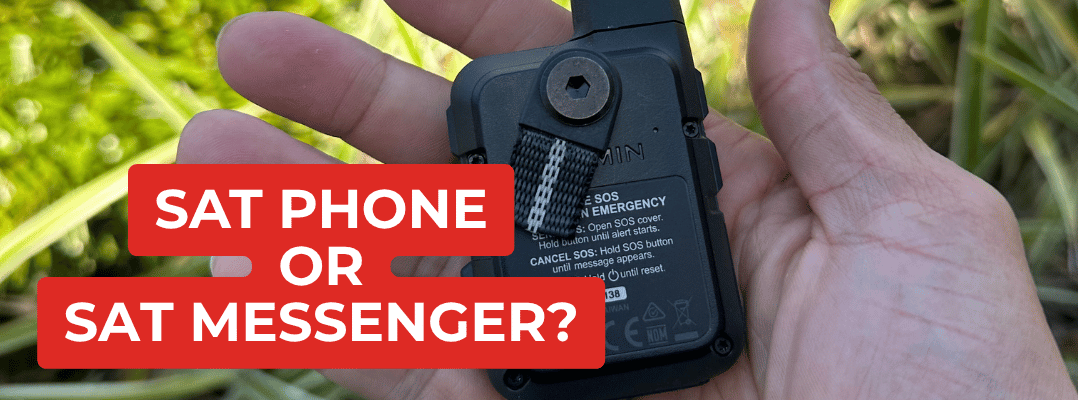
If you’ve researched emergency communication for hiking, boating, or remote travel, you’ve probably run into this question: why pay more for a satellite phone when a Garmin inReach or Zoleo can send an SOS for less?
It’s a fair question, and the honest answer depends on what “emergency communication” means for your trip. Our team hears three reasons people buy satellite connectivity. Eric, one of our satellite communications experts, sums them up as “stay safe, stay connected, and stay in touch.” A messenger and a phone can both help you stay safe. Where they differ is how well they let you stay in touch when things get complicated.
What a satellite messenger is built for

Satellite messengers are small, lightweight devices built around text messaging and an SOS button. For a weekend backpacking trip, a day hike outside cell range, or routine check-ins with home, that covers most recreational needs. If your worst case is “press a button and wait for help,” a messenger does that job well for less money.
Iridium CEO Matt Desch has noted that services like texting and SOS are the easy part of satellite communication: “Narrowband voice, texting voice, SOS services... aren’t difficult to provide.” That’s why so many devices now offer them, and why a messenger is a reasonable starting point for many people.
Where the gap shows up
The limitation is conversation. Messengers are built for short messages. In a real emergency, what you often need is a back-and-forth. You might have to explain an injury to a dispatcher, talk a family member through a decision, or coordinate in real time with a boat captain, guide, or search team. Typing all of that out under stress is a very different experience from simply talking.
A satellite phone is built for exactly that. As Eric puts it, drawing on 18 years in the industry: “If it’s business related, and it’s not just leisure recreational, I still want a geostationary satellite phone. I wanna talk for an hour. If I need to not have drop calls, it can be very important.”
What about the satellite SOS on my smartphone?
Newer smartphones can send emergency messages over satellite, which raises the bar for “good enough” on casual trips. Desch doesn’t expect that to replace dedicated devices soon. He has said it will likely take five to 10 years before widespread higher-speed satellite service reaches everyday phones. For now, treat phone-based satellite features as a last-resort safety net, not a way to hold a conversation.
Coverage and conditions matter too
Not every satellite phone network covers the same ground:
- Iridium uses 66 cross-linked satellites in low Earth orbit and reaches from pole to pole.
- Inmarsat uses geostationary satellites covering roughly 99% of the globe, excluding the extreme poles.
Both networks run on L-band frequencies, which hold up well in rain and heavy cloud. Desch describes Iridium’s spectrum as able to “go through rain showers.” That matters if your emergency is more likely to happen in bad weather than in good. Like any satellite device, a satellite phone still needs a clear view of the sky to connect.
A real-world example
One of our customers runs a charter fishing boat out of Florida. He routinely heads 40 miles offshore with no cell service and relies mainly on VHF radio. After researching his options, he added a satellite phone and explained the value this way: “For the amount of minutes you get, it’s a great deal. I highly recommend this to anybody who wants a little reassurance and contact with people on tour.”
For him, it wasn’t about having an SOS button. It was about being able to talk to people on shore. Another customer, a self-described survivalist who travels constantly, reached the same conclusion through research: “this was the one that I found for the best value and the best coverage.”
So which one is worth it for you?
Ask yourself two questions:
- Would a text-based SOS and basic check-ins cover my worst-case scenario? If you’re mostly taking weekend trips, day hikes, or doing casual outdoor recreation, a satellite messenger is the financially sensible choice. There’s no reason to pay for a phone you won’t fully use.
- Could my situation require a real voice conversation, extended talk time, or use for work? This covers things like offshore work, remote job sites, leading expeditions, or travel where infrastructure is thin. If so, the extra cost of a satellite phone buys something a messenger isn’t designed to provide: real-time, two-way voice when it counts.
Neither device is “better” in general. They’re built for different situations. The mistake is choosing on price alone instead of on what happens if your emergency isn’t a simple one.