
Globalstar Network and Coverage
Globalstar satellite technology makes it easy to find a clear and secure connection outside of areas where traditional network communication isn’t possible.
Maintaining communication functions related to work and everyday life beyond the confines of cellular network ranges can be a challenge. But Globalstar, a leading provider of satellite solutions, has created innovative technology that allows users on the network to utilize voice and data service from almost anywhere in the world.
Why choose Globalstar Satellite Network?
Globalstar does have competition, however, and it’s not your only option for reliable satellite communication. But they’ve proven their technology in the industry and there are plenty of excellent reasons to choose Globalstar for your remote connection needs whether it’s for business or pleasure.
One clear advantage over the competition is the way the infrastructure is designed. Globalstar has 24 ground stations that serve as a bridge between its 48 Low Earth-Orbiting (LEO) satellites. This allows engineers to make adaptations as customers’ needs evolve, while delivering feature-rich connection with a great user experience.
What can you expect when you choose a device that operates on the Globalstar network?
- The ability to stay connected anytime and anywhere to the ones in your life who matter most.
- Streamlined day-to-day business with an efficient global connection.
- The confidence in a network that will propel your business forward. They have a proven track record in the following industries: government and public safety, transportation, energy, construction, commercial maritime, agriculture, and forestry.
- A team of experts constantly working hard to continue improving the platform’s connectivity and productivity to adapt to an ever-growing and changing world.
- Not being just a number. Globalstar’s mission is to meet the needs of each and every customer and exceed their communication demands.
- A company that is literally saving lives by enabling the highest standard of lifesaving technology that comes with the push of a button.
- Affordable, uninterrupted, high-quality service that you can depend on whenever you need it.
In short, you want a device that you know will work as expected wherever you might end up. Whether that’s to call loved ones back home, close an important business deal, or know help is at your fingertips in the event of an emergency, Globalstar is a solid choice.
Globalstar Coverage and Coverage Maps
Now that you know how effective Globalstar can be for the array of communication needs that you require, let’s talk about coverage.
Unlike Iridium, which offers a 100% pole-to-pole global coverage, there are some areas of the world where Globalstar can’t reach. Knowing exactly where Globalstar functions best will help you choose wisely for your satellite connection needs.
Globalstar Satellite Phone Coverage
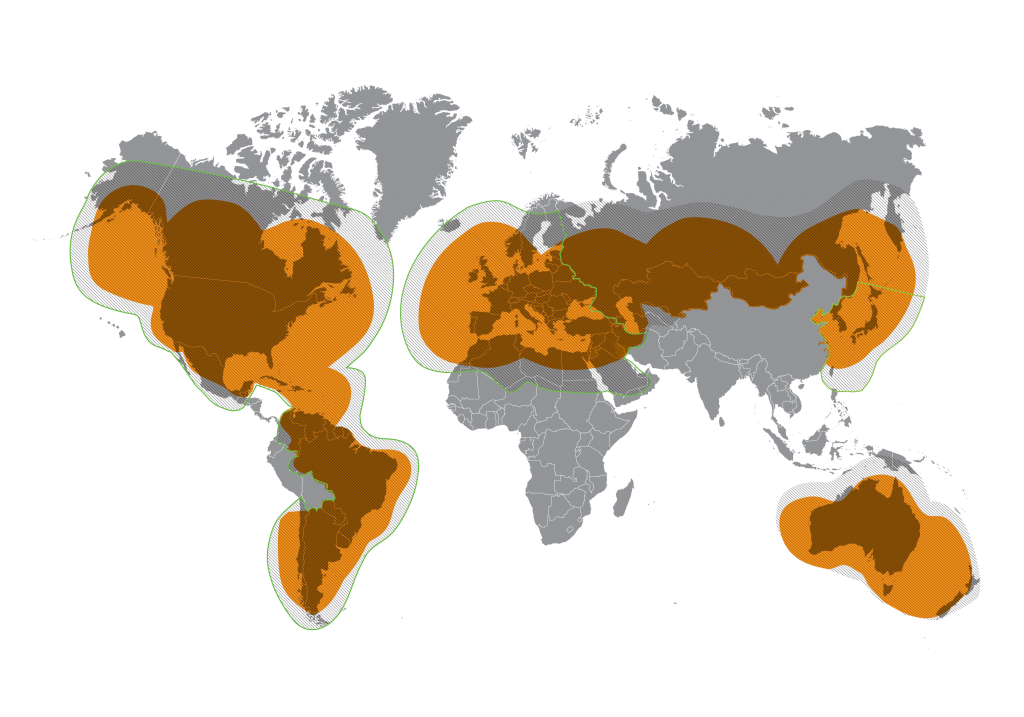
Your Globalstar satellite phone will work seamlessly in the following areas of the world:
- Most of North America including all of the lower 48 states
- Most of South America
- The majority of Europe including the southernmost portions of Norway and Sweden
- Australia
- Northern portions of Asia as well as Japan
- Several off-shore locations and waterways
To view the entire coverage area for Globalstar’s satellite phones, see the coverage map below.
Globalstar SPOT Coverage
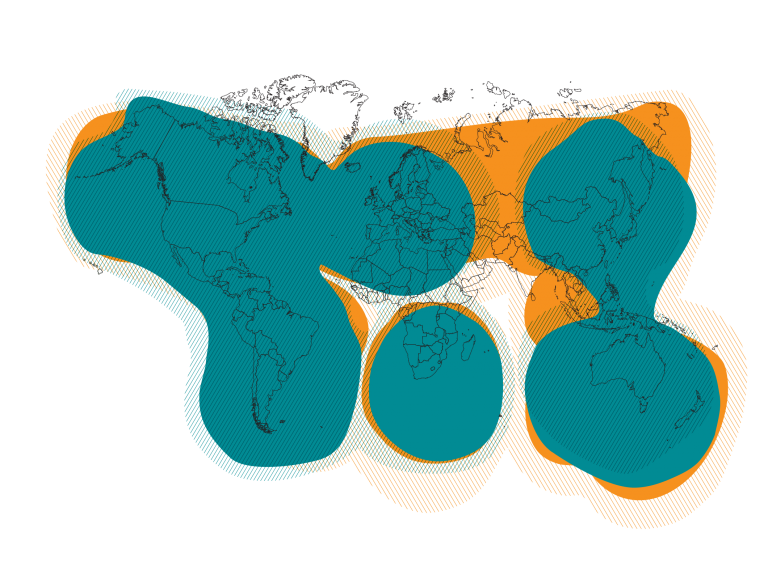
SPOT has the most extensive coverage that Globalstar provides. Because it is a less complex system designed for emergencies and location tracking, users are able to use it in most parts of the world, including over many ocean areas. The poles are out of reach as is a central portion of Africa, otherwise it is a smart lifeline solution for most areas to which you may travel.
To view the entire coverage area for Globalstar SPOT, see the coverage map below.
Globalstar Sat-Fi Hotspot Coverage
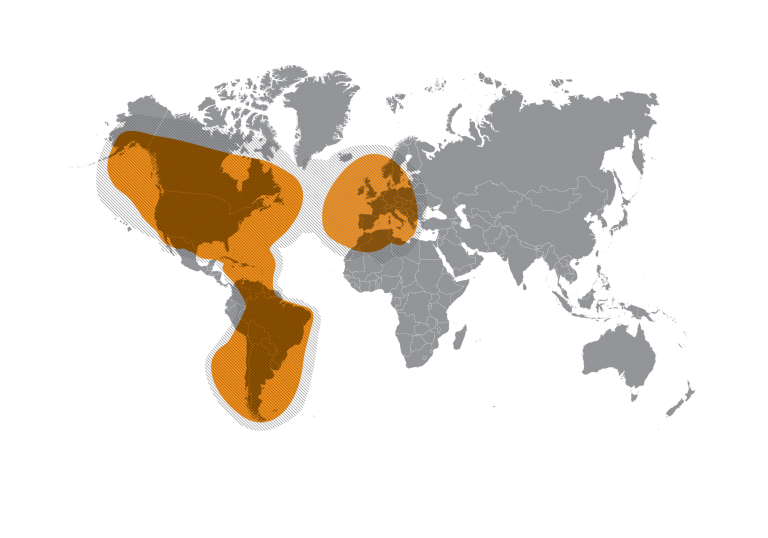
Though you’ll find that the sat-fi coverage offered by Globalstar is smaller in area than its phone and SPOT coverage, it still gives users connecting within the lower 48 states a 100% usable satellite solution. It also available throughout Western Europe, most of South America and some close connected areas as well. You’ll also find nearby ocean coverage, as well. If that’s where you plan to travel, Globalstar’s Sat-Fi Hotspot is the perfect solution to turn your own smartphone into a Wi-Fi hotspot.
To see where Globalstar’s Sat-Fi Hotspot functions, see the coverage map below.
Get to Know Globalstar
Globalstar is an American company that began bringing satellite voice and coverage data to users in 1999. Today, it offers both voice and data service in six continents.
This provider of satellite solutions brings superior satellite communication to the masses via a Low Earth Orbiting constellation consisting of 48 orbiting satellites. They sit 700 miles above earth in various locations to create as wide of a reach as possible. This low altitude, as compared to geostationary satellites that operate 22,000 miles above Earth, is what allows for low-latency data transmission.
Via land or sea, both commercial and recreational users operating within Globalstar’s expansive coverage area will find quality communication service no matter which product they choose to use.
Products Operating on the Globalstar Network
Globalstar offers a wide range of satellite voice and data products to meet the wide range of needs among its customers including SPOT Life-Saving Technology, voice and data devices, as well as commercial IoT solutions.
SPOT Life-Saving Technology
Perhaps you need nothing more on your remote adventure than a safety connection should you need it. We understand that part of the allure of going off the grid is the ability to completely unplug, so you may want to leave the satellite phone behind. What you never what to compromise, however, is your life.
A SPOT Global Satellite GPS Messenger is the perfect solution for the person who prefers to avoid typical communication service that a phone can provide. But your loved ones and colleagues will be at ease knowing you are OK, and you’ll appreciate the peace of mind that you can get help with the push of a button.
For further details, check out the SPOT Gen 3 and SPOT Gen 4 devices.
Voice and Data
Portability and reliability are the name of the game when it comes to your satellite phone. And with reliability comes knowing that you’ll have a crisp and clear connection on both sides of the call. And what about data transmission (email, text messaging, social media posting, etc.)? You should expect nothing less than the ability to relay information quickly…that’s what you’re paying for after all.
Globalstar offers an array of voice and data options.
Satellite Phones:
Key features of the GSP-1600 satellite phone include:
- Easy access to satellite voice and data services
- Crystal clear voice quality
- Automatically selects necessary system via easy to use antenna
- Simple installation for vehicles, vessels and portable docking kits
Key features of the GSP-1700 satellite phone include:
- Globalstar’s smallest and lightest phone
- Ultimate handheld ergonomic design
- Fast data speeds at 9.6 Kbps
- Position Location Service
Are there any cons of using Globalstar?
It’s easy to see why Globalstar is the perfect satellite solution for so many users. But they’re not the only option available and like any satellite network, it isn’t perfect.
The downside to Globalstar that you’ll find is that its network’s coverage is limited to certain parts of the world. Though you’re still getting around 80% worldwide coverage (depending on the product), that also means it won’t work everywhere. Keep in mind how big our world is however, and where you’re headed.
This is only a downside if you plan on traveling to a part of the world that is outside of Globalstar’s coverage. Otherwise, if you plan to travel within the confines of this still massive area which includes over 120 countries, you know you can expect premium voice quality and low latency transmission – all at an accessible price point.
Globalstar Coverage Comparison at a Glance
Use the following chart to find out how Globalstar compares to other leading satellite networks available to you
| Network | Globalstar | Inmarsat | Iridium | Thuraya |
|---|---|---|---|---|
| % of Global Coverage | 80% | 90% | 100% | 90% (including roaming) |
| Polar Coverage | No | No | Yes | Limited |
| LEO or Geostationary Satellites | Low-Earth | Geostationary | Low-Earth Orbiting (LEO) | Geostationary |
| Number of Satellites | 48 (plus 4 spares) | 13 | 66 (plus 9 spares) | 2 |
| Satellite Phone and Devices Coverage Map | Globalstar Coverage Map | Inmarsat Coverage Map | Iridium Coverage Map | Thuraya Coverage Map |
| Pros |
Premium voice quality Great for lower 48 states Good for people on a budget |
Great value Color screen Covers most of the world |
100% Global Coverage Land, Sea, Air No gap in coverage Small, compact, easy to use |
Global network access From most locations |
| Cons |
Parts of the world remain out of reach Delayed connection at times |
No polar connectivity Antenna makes phone bulky |
Higher Cost |
Expect higher charges when roaming on GSM services No coverage in North America and some other countries |
| Voice Service Plan Cost | Monthly plans starting at $49.99 | Monthly plans starting at $49.99 | Monthly plans starting at $59.99 | Monthly plans starting at $39 |
Further Coverage Information
Looking for more information on the other top satellite networks? Further comparisons can be found on our network coverage page.
For each of the following networks you can find out the extent of coverage, see data and satellite phone coverage maps, and the range of products that operate on each platform by going to each network’s individual page.