

Bivystick

2
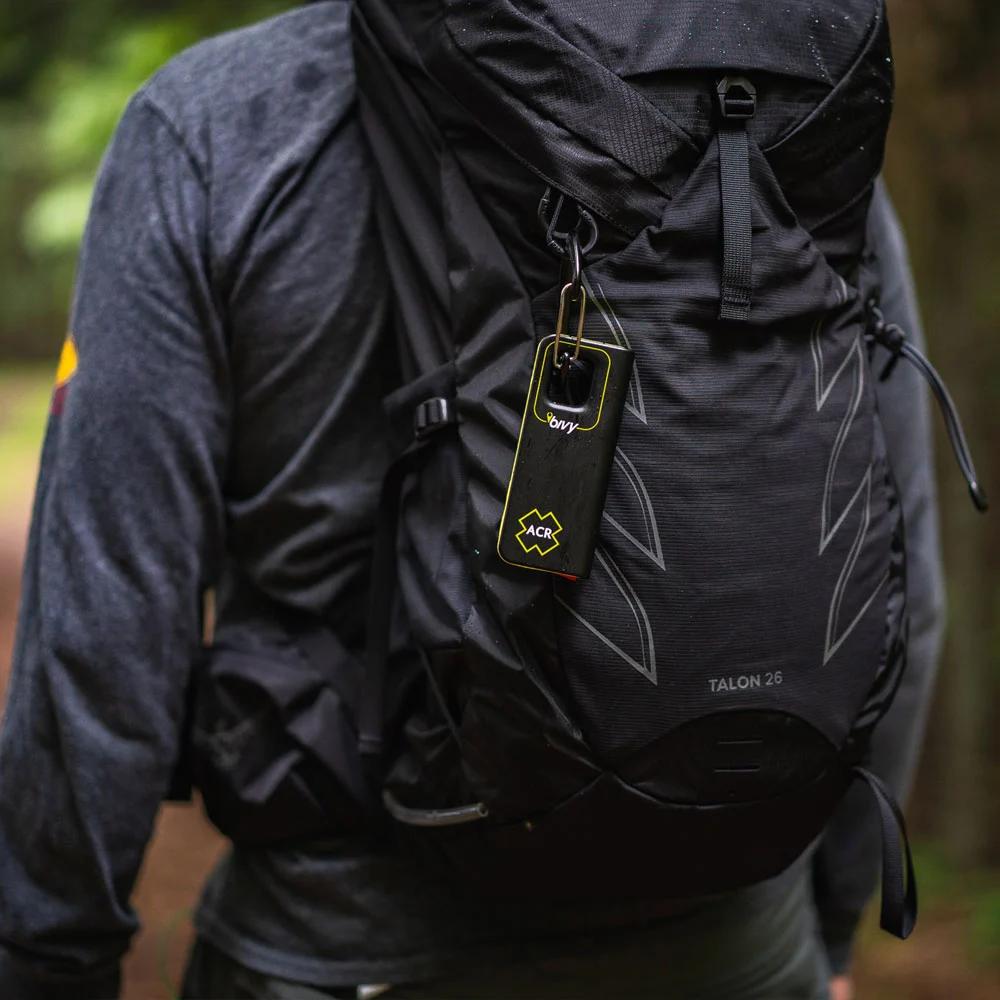
Bivy Stick mounted on a pack strap or bike handlebar on a singletrack trail, rider or hiker in motion, phone clipped nearby.

Satellite Trackers / Bivy Stick

ACR Bivy Stick: The Lightweight Two-Way Satellite Messenger

At 112 grams the Bivy Stick is the lightest Iridium messenger we sell, with an SOS button monitored by Global Rescue, a one-touch check-in, and an app with offline maps and more than 50,000 routes. It leans on your phone to type, and that is the trade to understand before you buy.

Who the Bivy Stick is for

The Bivy Stick is for people who count grams and already plan their trips on a phone. Trail runners, bikepackers, climbers, backcountry skiers and paddlers clip it to a strap or a GoPro mount and forget it is there until they need it. It pairs to the Bivy app over Bluetooth Low Energy, and the app does everything: two-way texts to any phone number or email, location sharing, weather reports, and adventure tracking with pace, mileage and altitude over 50,000-plus preloaded routes across 20 activity categories.

Two things work without the phone, and they are the two that matter most. The SOS button is recessed to prevent accidental activation and connects you to Global Rescue's 24/7 monitoring team. The check-in button sends an unlimited number of preset messages with your position to the contacts you set up. Incoming messages arrive on a dedicated phone number and email, so people back home do not need the app.

It is not for you if you want to type a message on the device itself, or if you want a screen and navigation in your hand. The Garmin inReach Mini 2 and Messenger do that. It is also the wrong device if you want no monthly fee at all: the ACR ResQLink View PLB is the same company's answer to that, and our help centre has a short video on choosing between them.

Bivy Stick at Satmodo

The current ACR Bivy Stick, plus the earlier-generation Bivystick listing. The ACR unit is the one we recommend; the earlier model is a different design.

ACR Bivy Stick vs Garmin inReach Mini 2 vs ZOLEO

The three Iridium messengers a Bivy Stick shopper usually weighs up. Figures from acrartex.com, Garmin's announcement and zoleo.com.

ACR Bivy StickGarmin inReach Mini 2ZOLEO Satellite Communicator
NetworkIridiumIridiumIridium, plus cellular and Wi-Fi when available
Weight3.95 oz (112 g)3.5 oz5.3 oz (150 g)
Size4.51 x 1.86 x 0.83 inJust under 4 in tall by 2 in wide3.58 x 2.6 x 1.06 in
Messaging without a phoneSOS and check-in buttons onlyFull two-way messaging on the deviceSOS and check-in buttons only
Message length160 charactersNot statedNot stated
SOS monitoringGlobal RescueGarmin IERCCGlobal Rescue
Check-inUnlimited custom check-ins, one buttonNot statedDedicated check-in button
BatteryUp to 120 hours plus 2-hour SOS reserve; 4 to 5 hour rechargeUp to 14 days at 10-min tracking; up to 30 days at 30-minOver 200 hours
Water and dustIP66IPX7IP68, 1.5 m for 30 min
NavigationOffline maps and 50,000-plus routes in the Bivy appTracBack routing and digital compass on deviceNone
MountingGoPro compatible with included quarter-20 adapterCarabiner and clipLanyard and carabiner; belt and vehicle mounts optional
ChargingUSB-CNot statedUSB-C
SubscriptionRequired, monthlyRequired, monthly or annualRequired, monthly

ACR currently publishes the Bivy Stick at IP66 and 112 g; the Satmodo listing and our help centre spec sheet show IPX7 and 100 g from an earlier data sheet. We use the manufacturer's current figures here.

How to decide between the Bivy Stick and the alternatives

Three honest questions.

1

Is weight the deciding factor?

At 112 g the Bivy Stick is lighter than a ZOLEO and close to an inReach Mini 2, and its slim shape rides flat on a strap. If every gram counts and your phone is already the trip computer, this is the one. If you would rather carry a few more grams and not depend on the phone, the Mini 2 is the answer.

2

Do you already live in an outdoor app?

The Bivy app is the reason the device exists: offline maps, a route library, and tracking that records pace and elevation alongside your messages. Runners, riders and climbers who want one app for planning, recording and messaging get the most out of it. If you never open trip apps, the extra features are wasted.

3

Will you accept a monthly plan?

Messaging, check-ins, tracking and SOS all need an active Bivy subscription, billed monthly. The pattern we see is people running it for a season and pausing over winter. If you want no plan at all, ACR's own ResQLink View PLB is the right product and costs nothing to keep.

The older Bivystick and the current ACR Bivy Stick

Two Bivy Stick listings appear on this page. The ACR Bivy Stick is the current unit, made by ACR Electronics, the company behind the ResQLink beacons: USB-C charging, up to 120 hours of battery with a two-hour SOS reserve, and the current Bivy app and plans. The listing named Bivystick is the earlier design from before ACR took over the product, which included a large internal battery intended to charge your phone.

If you are choosing today, choose the ACR Bivy Stick. It is the model ACR supports with firmware updates, the help centre articles below are written for it, and it is the unit our specialists carry. Call us if you have the earlier model and want to know whether it can still be activated.

The current ACR Bivy Stick in its tall green form on a rock ledge with a climbing helmet and phone, clean product-in-place shot.

What you need alongside a Bivy Stick

In the box: the device, a USB-C charging cable, a carabiner, a cord and a quarter-20 mount adapter. Add these.

An active Bivy subscription, activated in the app before the trip. No plan means no messages, no check-ins and no SOS.
An iOS or Android phone with the Bivy app installed and paired over Bluetooth, plus a power bank to keep the phone alive.
Your check-in contacts and emergency contacts entered in the app, and a note to them explaining what a check-in and an SOS mean.
A mount that keeps the antenna facing the sky: the included adapter fits GoPro mounts; ACR also offers a mounting kit, quick-release buckle, suction mount, clamp, bike mount and solar panel.
A test message and a test check-in outdoors with a clear view of the sky, confirmed by the recipient, before you leave coverage.
The latest firmware, updated through the app; the help centre has the steps.

Bivy Stick or PLB? Ask someone who carries both.

Satmodo activates Bivy plans, walks you through pairing and the first test message, and will tell you straight when a ResQLink or an inReach is the better fit for your trip.

Call (800) 279-2366

Keep reading

Frequently asked questions

Does the Bivy Stick work without a phone?
The SOS and check-in buttons on the device work on their own; composing and reading messages requires the Bivy app on a paired iOS or Android phone. If your phone dies you can still call for help and send a preset check-in, but you cannot type. For messaging on the device itself, choose a Garmin inReach.
Does the Bivy Stick require a subscription?
Yes. A monthly Bivy subscription is required for messaging, check-ins, tracking and SOS. Many users run a plan through their active season and pause it afterwards. Satmodo can activate the plan with you.
How long does the Bivy Stick battery last?
ACR rates it at up to 120 hours of standard operation at default settings, with a separate 2-hour SOS reserve so an emergency alert can still go out on a depleted unit. A full recharge takes 4 to 5 hours from a USB-A port and less from a USB-C charger.
Where does the Bivy Stick work?
Anywhere on Earth with a clear view of the sky. It uses the Iridium satellite network, which provides truly global coverage including the polar regions and the oceans. It will not work indoors, under a metal roof or deep in a canyon.
What happens when I press SOS on a Bivy Stick?
The device sends your GPS position to Global Rescue's 24/7 monitoring centre, which coordinates the appropriate search and rescue and messages you back through the Bivy app so you can describe the situation. The button is recessed so a pack strap cannot trigger it.
Can people text my Bivy Stick from a normal phone?
Yes. Each Bivy Stick has a dedicated phone number and email address. Contacts send an ordinary SMS or email and it arrives on your paired phone through the Bivy app over Iridium. Messages are limited to 160 characters.
Is the Bivy Stick waterproof?
ACR currently rates it IP66, which means dust-tight and protected against powerful water jets, so rain, spray and splashing are fine. Earlier data sheets, including the one on our product page, show IPX7. Either way it is not designed for submersion or diving.
What is the difference between the Bivy Stick and the Garmin inReach Mini 2?
The Bivy Stick is lighter and slimmer, mounts on GoPro hardware, and runs through the Bivy app for typing, maps and routes; the inReach Mini 2 types and reads messages on the device, has TracBack navigation and a compass, and runs up to 14 days at 10-minute tracking versus up to 120 hours. Both use Iridium and both need a subscription.
Bivy Stick or a PLB like the ACR ResQLink View?
The Bivy Stick if you want two-way texting, check-ins, weather and tracking and accept a monthly plan; the ResQLink View if you only want a rescue button with no subscription, a five-year battery and a 406 MHz signal to search and rescue. Many solo travellers carry both because they fail in different ways.
Loading...

Expert Tip: Getting the Most Out of Your Bivystick

The Bivystick performs best when used strategically. Satellite messaging is slower than standard SMS, so expect approximately 30–60 seconds for a message to transmit. To save time in the field, pre-write common messages—such as safety check-ins or arrival confirmations—before leaving cellular service so you can send them quickly when needed.

Clear sky visibility is essential for reliable satellite connection. In canyons, dense forests, or obstructed terrain, move to a clearing or ridgeline to improve transmission. For optimal signal performance, clip the Bivystick to the outside of your pack with the logo facing upward, as the antenna is positioned on that side.

FAQs:

  • Does the Bivystick require a subscription? Yes. The Bivystick operates on the Iridium satellite network and requires an active service plan for messaging and tracking. Plans range from basic check-in packages to unlimited messaging options.
  • What phones are compatible with the Bivystick? The Bivystick connects via Bluetooth to both iOS and Android devices. Simply download the Bivy app to send messages, view maps, and manage tracking features. Your phone does not need cellular service—only Bluetooth connectivity to the device.
  • How long does the Bivystick battery last? Battery life averages about 24 hours with continuous tracking, or several days on standby with periodic check-ins. Actual duration depends on tracking intervals and message frequency. A small power bank is recommended for extended trips.
  • Can recipients reply to my satellite messages? Yes. Two-way messaging allows contacts to reply via email or through the Bivy web portal, with responses routed back to your phone through the Bivystick device.
  • Does the SOS feature work in remote areas? Yes. The Bivystick uses the Iridium satellite network for global coverage, including remote and polar regions. SOS alerts are routed to a 24/7 emergency response coordination center that works with local search and rescue teams.
Loading...